Business Proposal
A business proposal is how you ask a client to hire your firm. It frames the problem, the commercial offer, and the price. It is not a quote, and it is not a project plan.
What's Included
- Executive Summary
- Client Objectives & Challenges
- Proposed Solution & Phased Scope
- Commercial Investment & Pricing Table
- Terms & Acceptance Authorization
Best For
Consulting bids, agency project proposals, enterprise technology implementations, and formal client service agreements.
Target Audience
Founders, sales directors, project managers, account executives, and agency leads.
How to Customize
Tailor the executive summary to the client’s metrics. Adjust the three-phase scope table to match how you actually deliver. Do not treat the signature block as a lawyer-drafted contract.
When to Use
Use this when you are pitching services and commercial terms together — consulting, agency work, or a professional-services engagement. If the client already chose you and only the project needs approval, use a Project Proposal. If they are picking among packaged options, use a Sales Proposal.
Full Document Preview
Modern StylePreview the actual editable ZuffSuite document.
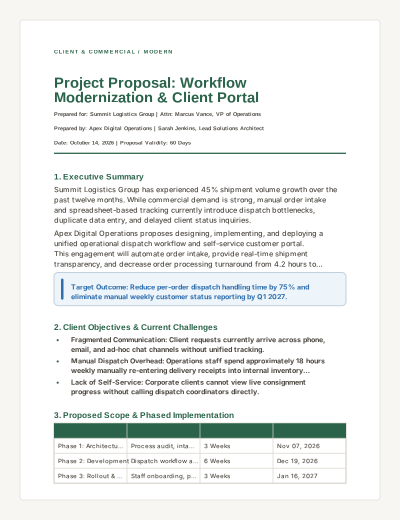
CLIENT & COMMERCIAL / MODERN
Project Proposal: Workflow Modernization & Client Portal
Prepared for: Summit Logistics Group | Attn: Marcus Vance, VP of Operations
Prepared by: Apex Digital Operations | Sarah Jenkins, Lead Solutions Architect
Date: October 14, 2026 | Proposal Validity: 60 Days
1. Executive Summary
Summit Logistics Group has experienced 45% shipment volume growth over the past twelve months. While commercial demand is strong, manual order intake and spreadsheet-based tracking currently introduce dispatch bottlenecks, duplicate data entry, and delayed client status inquiries.
Apex Digital Operations proposes designing, implementing, and deploying a unified operational dispatch workflow and self-service customer portal. This engagement will automate order intake, provide real-time shipment transparency, and decrease order processing turnaround from 4.2 hours to under 20 minutes.
Target Outcome: Reduce per-order dispatch handling time by 75% and eliminate manual weekly customer status reporting by Q1 2027.
2. Client Objectives & Current Challenges
Fragmented Communication: Client requests currently arrive across phone, email, and ad-hoc chat channels without unified tracking.
Manual Dispatch Overhead: Operations staff spend approximately 18 hours weekly manually re-entering delivery receipts into internal inventory sheets.
Lack of Self-Service: Corporate clients cannot view live consignment progress without calling dispatch coordinators directly.
3. Proposed Scope & Phased Implementation
Phase | Key Deliverables | Duration | Target Sign-Off |
|---|---|---|---|
Phase 1: Architecture | Process audit, intake taxonomy, database schema specification | 3 Weeks | Nov 07, 2026 |
Phase 2: Development | Dispatch workflow automation, portal UI, client role permissions | 6 Weeks | Dec 19, 2026 |
Phase 3: Rollout & QA | Staff onboarding, pilot client testing, legacy data migration | 3 Weeks | Jan 16, 2027 |
4. Commercial Investment & Pricing
Item Description | Billing Type | Amount (USD) |
|---|---|---|
Discovery, Workflow Engineering & Schema Architecture | Fixed Milestone | $12,500 |
Dispatch Engine & Client Portal Development | Fixed Milestone | $28,000 |
Operational Training, Migration & 60-Day Hypercare | Fixed Milestone | $8,500 |
Total Professional Services Engagement | All Inclusive | $49,000 |
5. Terms & Acceptance Authorization
To accept this proposal and authorize commencement of Phase 1 Discovery, please sign and return this authorization. A formal Master Services Agreement (MSA) and Scope of Work (SOW) will be finalized within five business days.
Accepted on behalf of Summit Logistics Group:
Signature: ___________________________ Date: ______________
Name: Marcus Vance Title: VP of Operations
What this document is
A business proposal presents a client-facing offer: the problem you understood, the work you recommend, how long it takes, and what it costs. Use it when the client still needs to choose you.
When to use it
Use this when you are pitching services and commercial terms together — consulting, agency work, or a professional-services engagement. If the client already chose you and only the project needs approval, use a Project Proposal. If they are picking among packaged options, use a Sales Proposal.
How to use this ZuffSuite template
Open with the client’s problem, not your bio. Keep phases and prices in tables. If the proposal is accepted, follow it with a Scope of Work so execution has a boundary.
Best practices
- Lead with the client’s situation before your credentials.
- Price in components, not only a lump sum.
- Name what happens after they say yes.
Common mistakes
- Sending a quote with no problem statement and calling it a proposal.
- Using the same document as a project plan after kickoff.
- Promising legal enforceability from a template signature line.
Related documents
Business Proposal vs. Quote
A quote is a price. A business proposal is the argument plus the price — problem, approach, timeline, and commercial terms together.
Business Proposal vs. Project Proposal
A business proposal sells the firm and the engagement. A project proposal asks a sponsor to approve one defined body of work. They are related, not interchangeable. Project Proposal
Questions people actually ask
- Is this the same as a project proposal?
- No. Use this template when you still need to win the commercial relationship. Use a Project Proposal when the work itself is what needs approval.
- Should I attach a scope of work?
- After the client accepts, yes. The proposal persuades; the Scope of Work locks what will and will not be performed.
Related templates
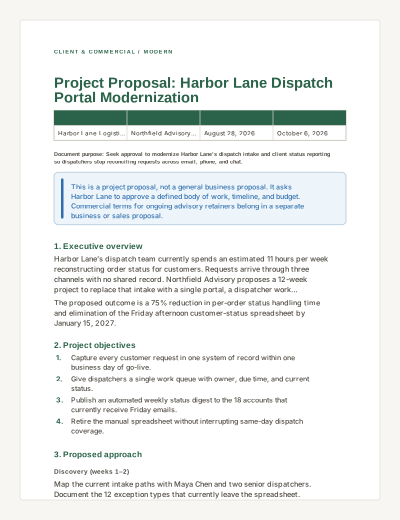
Project Proposal
A structured project proposal outlining objectives, scope boundaries, deliverables, milestones, team roles, and budget for stakeholder approval.
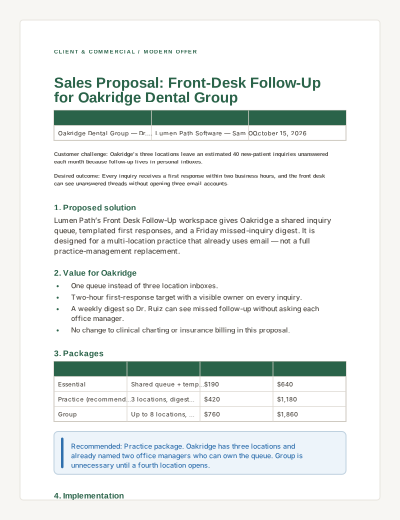
Sales Proposal
A persuasive but professional offer that maps a customer challenge to a packaged solution, pricing, and next step.
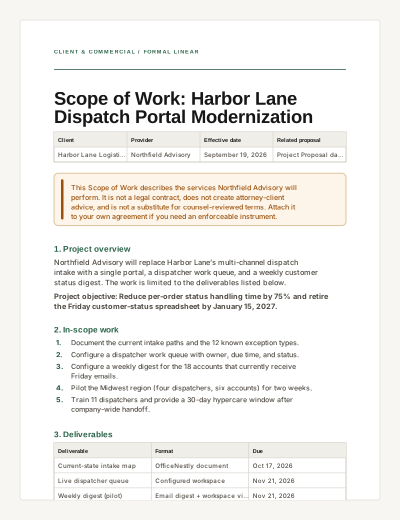
Scope of Work
Define exactly what work will and will not be performed — deliverables, exclusions, acceptance, and change handling.