Project Proposal
A project proposal is how you get approval for a specific body of work. It outlines the problem, the solution, the deliverables, and what it will cost.
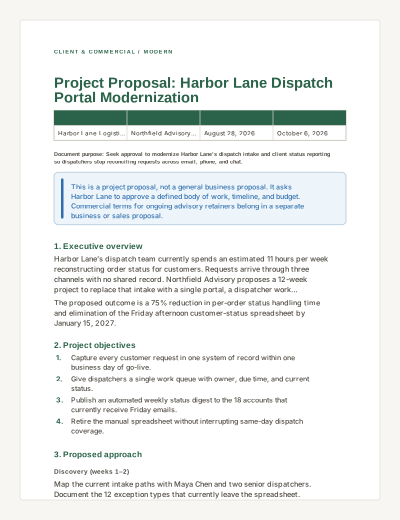
What's Included
- Executive overview
- Project objectives
- Proposed approach
- Scope of work (in/out)
- Deliverables
- Milestones and timeline
- Team and responsibilities
- Investment
- Assumptions
- Next steps
Best For
Internal initiatives, client project sign-offs, workflow modernizations, and fixed-fee professional services engagements.
Target Audience
Project managers, team leads, consultants, and operations directors proposing a discrete initiative.
How to Customize
Update the Harbor Lane example content with your project specifics. Adjust the timeline and milestone gates to match your governance model. Keep the out-of-scope section clear to prevent scope creep.
When to Use
Use a Project Proposal when you have a defined project needing approval from an internal sponsor or existing client. If you are pitching your firm’s commercial services for the first time, use a Business Proposal. If you need a binding execution document, follow this with a Scope of Work.
Full Document Preview
Modern StylePreview the actual editable ZuffSuite document.
CLIENT & COMMERCIAL / MODERN
Project Proposal: Harbor Lane Dispatch Portal Modernization
Prepared for | Prepared by | Proposal date | Proposed start |
|---|---|---|---|
Harbor Lane Logistics — Maya Chen, VP Operations | Northfield Advisory — Jordan Hale, Principal | August 28, 2026 | October 6, 2026 |
Document purpose: Seek approval to modernize Harbor Lane’s dispatch intake and client status reporting so dispatchers stop reconciling requests across email, phone, and chat.
This is a project proposal, not a general business proposal. It asks Harbor Lane to approve a defined body of work, timeline, and budget. Commercial terms for ongoing advisory retainers belong in a separate business or sales proposal.
1. Executive overview
Harbor Lane’s dispatch team currently spends an estimated 11 hours per week reconstructing order status for customers. Requests arrive through three channels with no shared record. Northfield Advisory proposes a 12-week project to replace that intake with a single portal, a dispatcher work queue, and a weekly customer status digest.
The proposed outcome is a 75% reduction in per-order status handling time and elimination of the Friday afternoon customer-status spreadsheet by January 15, 2027.
2. Project objectives
Capture every customer request in one system of record within one business day of go-live.
Give dispatchers a single work queue with owner, due time, and current status.
Publish an automated weekly status digest to the 18 accounts that currently receive Friday emails.
Retire the manual spreadsheet without interrupting same-day dispatch coverage.
3. Proposed approach
Discovery (weeks 1–2)
Map the current intake paths with Maya Chen and two senior dispatchers. Document the 12 exception types that currently leave the spreadsheet. Confirm which customer fields must appear on the digest.
Build (weeks 3–8)
Configure the portal, dispatcher queue, and digest in Harbor Lane’s existing ZuffSuite workspace and connected operations tools. No custom running headers, multi-column layouts, or unsupported editor features are required for the documentation deliverables in this project.
Pilot and handoff (weeks 9–12)
Run a two-week pilot with the Midwest region (four dispatchers, six accounts). Train the remaining team, freeze the old spreadsheet, and complete acceptance against the criteria in section 8.
4. Scope of work
In scope: intake form, dispatcher queue, weekly digest, training for 11 dispatchers, and a 30-day hypercare window. Out of scope: a customer mobile app, billing integration, and warehouse barcode hardware. Those items should be proposed separately if Harbor Lane wants them.
5. Deliverables
Deliverable | Owner | Acceptance signal |
|---|---|---|
Current-state intake map | Northfield Advisory | Maya Chen signs the map as complete |
Dispatcher work queue (live) | Northfield Advisory | Four Midwest dispatchers complete a live order in the queue |
Weekly customer digest | Northfield Advisory | Six pilot accounts receive the digest for two consecutive Fridays |
Training guide and SOP addendum | Northfield Advisory | All 11 dispatchers complete the training checklist |
6. Milestones and timeline
Milestone | Date | What “done” means |
|---|---|---|
Kickoff and access granted | Oct 6, 2026 | VPN, sample data, and dispatcher interviews scheduled |
Discovery complete | Oct 17, 2026 | Intake map approved |
Pilot ready | Nov 21, 2026 | Midwest region can process live orders |
Company-wide handoff | Dec 18, 2026 | Spreadsheet retired; hypercare begins |
Project close | Jan 15, 2027 | Acceptance criteria met; hypercare ends |
7. Team and responsibilities
Role | Person | Responsibility |
|---|---|---|
Executive sponsor | Maya Chen, Harbor Lane | Decisions within two business days |
Project lead | Jordan Hale, Northfield | Plan, budget, and weekly status |
Operations designer | Priya Shah, Northfield | Queue design and training |
Dispatcher champions | Luis Ortega & Dana Whit, Harbor Lane | Pilot feedback three times per week |
8. Investment
Phase | Fee | Includes |
|---|---|---|
Discovery | $9,400 | Interviews, intake map, exception catalog |
Build and pilot | $28,800 | Queue, digest, Midwest pilot, training draft |
Handoff and hypercare | $8,200 | Company rollout, 30-day support window |
Total | $46,400 | Fixed fee. Change requests follow the process in the Scope of Work. |
9. Assumptions
Harbor Lane provides dispatcher time (four hours per week during discovery and pilot).
The existing ZuffSuite workspace remains the system of record for documents and training.
No warehouse hardware or billing-system rebuild is required for this project to succeed.
10. Next steps
Maya Chen confirms the objectives and out-of-scope list.
Northfield issues the companion Scope of Work for signature.
Kickoff is held on October 6, 2026 if approval is received by September 19.
What this document is
A project proposal defines a discrete initiative — its objectives, approach, scope boundaries, deliverables, timeline, team responsibilities, and required investment — so a sponsor or client can approve kickoff.
When to use it
Use a Project Proposal when you have a defined project needing approval from an internal sponsor or existing client. If you are pitching your firm’s commercial services for the first time, use a Business Proposal. If you need a binding execution document, follow this with a Scope of Work.
How to use this ZuffSuite template
State the problem and measurable target outcome in section 1. Define explicit in-scope and out-of-scope boundaries in section 4. Use tables for deliverables and milestones with clear acceptance signals.
Best practices
- Clearly separate in-scope from out-of-scope items.
- Define concrete acceptance signals for each deliverable.
- Include a structured timeline with explicit 'done' criteria.
- Detail team roles so sponsor expectations are clear.
Common mistakes
- Leaving scope boundaries ambiguous.
- Failing to define who approves each milestone.
- Omitting assumptions about client/sponsor time commitment.
Related documents
Project Proposal vs. Business Proposal
A Business Proposal sells the firm and commercial relationship. A Project Proposal asks a sponsor to approve one defined body of work with explicit deliverables and timeline. Business Proposal
Project Proposal vs. Scope of Work (SOW)
A Project Proposal persuades and secures approval. A Scope of Work is the detailed, execution-level document that locks tasks, acceptance criteria, and terms after approval. Scope of Work
Questions people actually ask
- What is the difference between a project proposal and a project plan?
- A project proposal seeks approval and budget for an initiative. A project plan is created after approval to guide day-to-day execution and resource tracking.
- How detailed should the deliverables table be?
- Each deliverable should name the owner and a concrete acceptance signal (e.g., 'Sponsor signs map as complete') so there is no ambiguity when work is delivered.
Related templates
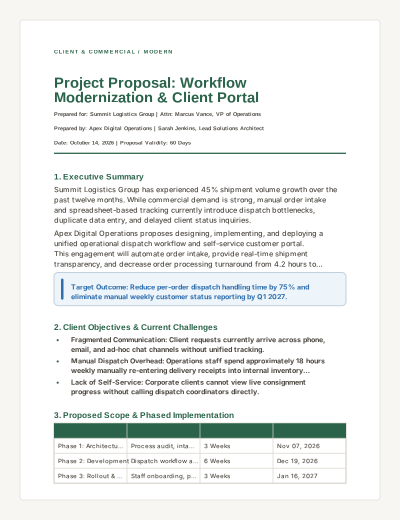
Business Proposal
A persuasive B2B proposal outline covering problem statement, solution, phased scope, pricing tables, and acceptance authorization.
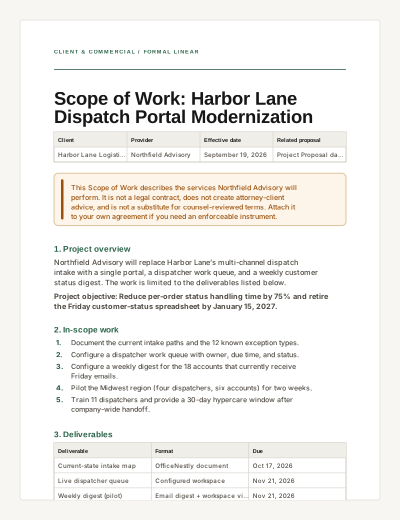
Scope of Work
Define exactly what work will and will not be performed — deliverables, exclusions, acceptance, and change handling.
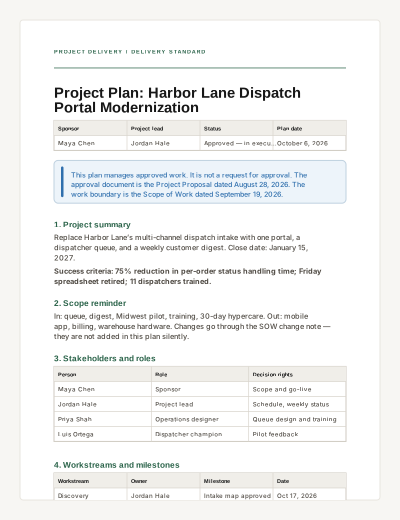
Project Plan
A living plan for approved work: objectives, roles, milestones, risks, cadence, and open decisions.