Traditional Business Plan
A traditional business plan provides the comprehensive narrative and financial structure required by banks, SBA lenders, and institutional partners.
What's Included
- Executive summary
- Company description
- Market analysis
- Organization and management
- Products and services
- Marketing and sales
- Funding request
- Financial overview (illustrative)
- Appendix and references
Best For
Bank loan applications, SBA 7(a) financing, formal investor diligence, commercial lease applications, and strategic multi-year planning.
Target Audience
Small business owners, entrepreneurs, loan applicants, and corporate planners.
How to Customize
Replace the RoastCraft LLC example with your company's specifics. Update market analysis and competitor tables to match your local industry landscape.
When to Use
Use a Traditional Business Plan when applying for commercial bank financing, SBA loans, enterprise supplier contracts, or commercial leases that require multi-year operational proof.
Full Document Preview
Standard StylePreview the actual editable ZuffSuite document.
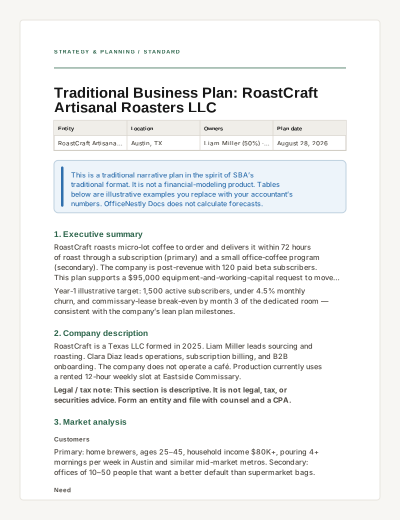
STRATEGY & PLANNING / STANDARD
Traditional Business Plan: RoastCraft Artisanal Roasters LLC
Entity | Location | Owners | Plan date |
|---|---|---|---|
RoastCraft Artisanal Roasters LLC | Austin, TX | Liam Miller (50%) · Clara Diaz (50%) | August 28, 2026 |
This is a traditional narrative plan in the spirit of SBA’s traditional format. It is not a financial-modeling product. Tables below are illustrative examples you replace with your accountant’s numbers. ZuffSuite Docs does not calculate forecasts.
1. Executive summary
RoastCraft roasts micro-lot coffee to order and delivers it within 72 hours of roast through a subscription (primary) and a small office-coffee program (secondary). The company is post-revenue with 120 paid beta subscribers. This plan supports a $95,000 equipment-and-working-capital request to move from a shared commissary slot to a dedicated 1,400 sq ft production room and to hire one full-time packer.
Year-1 illustrative target: 1,500 active subscribers, under 4.5% monthly churn, and commissary-lease break-even by month 3 of the dedicated room — consistent with the company’s lean plan milestones.
2. Company description
RoastCraft is a Texas LLC formed in 2025. Liam Miller leads sourcing and roasting. Clara Diaz leads operations, subscription billing, and B2B onboarding. The company does not operate a café. Production currently uses a rented 12-hour weekly slot at Eastside Commissary.
Legal / tax note: This section is descriptive. It is not legal, tax, or securities advice. Form an entity and file with counsel and a CPA.
3. Market analysis
Customers
Primary: home brewers, ages 25–45, household income $80K+, pouring 4+ mornings per week in Austin and similar mid-market metros. Secondary: offices of 10–50 people that want a better default than supermarket bags.
Need
Supermarket bags often sit 3–6 months. Coastal micro-roasters ship well but add $8–$12 freight that makes a $19 bag feel like $30. RoastCraft’s bet is 72-hour roast-to-door in Texas and adjacent states at $19.50 per 12 oz subscription bag with shipping included in-region.
Competition (plain view)
Player | What they optimize | Where RoastCraft differs |
|---|---|---|
Grocery private label | Shelf life and price | Roast date, not months-old inventory |
National subscription brands | Catalog breadth | Fewer SKUs, named lots, 72-hour promise |
Local cafés | By-the-cup experience | RoastCraft does not compete for seating; it ships |
4. Organization and management
Name | Role | Responsibility |
|---|---|---|
Liam Miller | Head roaster / sourcing | Green buying, roast profiles, QC |
Clara Diaz | Operations & growth | Subscription ops, packing SOPs, office accounts |
TBD packer (hire) | Production | Bag, label, and ship on roast days |
Advisors: Eastside Commissary manager (production constraints) and a bookkeeper on monthly close. No board. Owners draw $0 until month 6 of the dedicated room unless cash is above a two-month expense reserve.
5. Products and services
Core: 12 oz subscription bag, weekly / biweekly / monthly cadence, $19.50 in-region.
Add-on: one-time “gift box” (two bags + card) at $42.
B2B: 5 lb office bags on a Friday delivery route inside Austin, 12-week minimum.
Not in this plan: a café, alcohol, or white-label roasting for other brands.
6. Marketing and sales
Acquisition: farmers-market pop-ups (target CAC under $15), referrals (one free bag after three successful paid months), and a plain-language landing page. No paid social in month 1–2 of the dedicated room until packing can absorb volume.
Sales for offices: Clara runs a 20-minute tasting at the office; close is a 12-week written order, not a handshake. Onboarding uses a Client Onboarding Guide pattern so billing emails are collected once.
7. Funding request
Ask: $95,000 total. $62,000 for a used 12-kilo roaster and afterburner already quoted; $18,000 for the first six months of dedicated-room rent and utilities reserve; $15,000 for packaging inventory and the packer wage through month 3. Use of funds is capital and working capital — not owner bonuses.
Preferred structure (illustrative): SBA-style term loan or equipment note. Owners are not offering equity in this document. Any securities offering would require proper counsel — this plan is not an offering.
8. Financial overview (illustrative)
Illustrative only. Replace with accountant-prepared forecasts before sending to a lender.
Metric | Pilot (actual) | Year 1 (target) | Year 2 (target) |
|---|---|---|---|
Active D2C subscribers | 120 | 1,500 | 3,200 |
Monthly revenue | $4,400 | $58,500 | $124,800 |
Gross margin | 65% | 64% | 66% |
Full-time staff | 0 (founders only) | 1 (packer) | 3 (packer + driver + ops) |
9. Appendix and references
Green coffee import invoices (last three lots).
Eastside Commissary facility lease agreement.
12-kilo roaster equipment quote and inspection report.
What this document is
A Traditional Business Plan is a detailed, formal multi-section document outlining every aspect of a commercial enterprise — from company background and competitive analysis to management bios, capital asks, and pro forma forecasts.
When to use it
Use a Traditional Business Plan when applying for commercial bank financing, SBA loans, enterprise supplier contracts, or commercial leases that require multi-year operational proof.
How to use this ZuffSuite template
Complete sections 1–7 with your narrative strategy. Use the funding request section to detail exact equipment and working capital needs. Have your accountant prepare the pro forma numbers for section 8.
Best practices
- Detail exactly how loan funds will be spent (equipment, working capital, inventory).
- Include management bios that demonstrate relevant industry track record.
- Keep financial tables grounded in realistic historical or pilot unit economics.
Common mistakes
- Using a 1-page lean canvas when a lender requested a full SBA plan.
- Making unsupported revenue claims without market size data.
- Omitting a clear repayment or cashflow break-even timeline.
Related documents
Traditional Business Plan vs. Lean Business Plan
A Traditional Business Plan is a formal 10-section narrative document for lenders and investors. A Lean Plan is a 1-page agile canvas for early validation and founder alignment. Lean Business Plan
Traditional Business Plan vs. Business Proposal
A Business Plan models an entire commercial company and its capital structure. A Business Proposal pitches a specific client for professional services or consulting. Business Proposal
Questions people actually ask
- Is this template compliant with SBA loan applications?
- Yes. It follows the standard 9-section structure recommended by the U.S. Small Business Administration (SBA) for 7(a) and microloan financing.
- Does ZuffSuite calculate the financial numbers automatically?
- No. ZuffSuite provides structured narrative tables for your financial summary. You should prepare your detailed pro forma model with an accountant or CPA.
Related templates
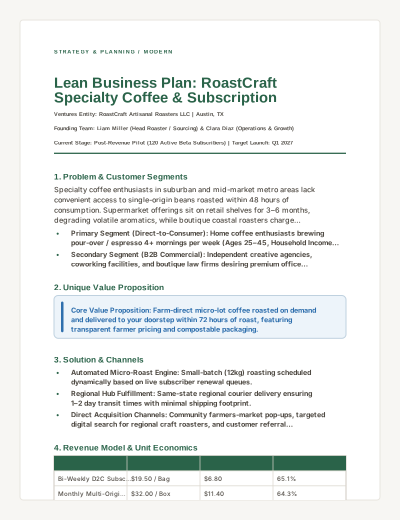
Lean Business Plan
A concise, actionable single-page business model plan covering value proposition, customer segments, channels, unit economics, and milestones.
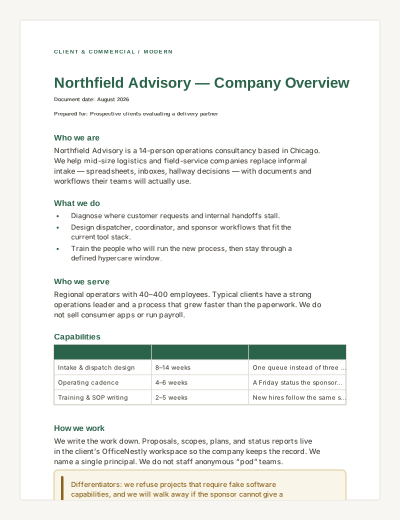
Company Overview
An external-facing company profile covering who you are, who you serve, capabilities, and how to get in touch.
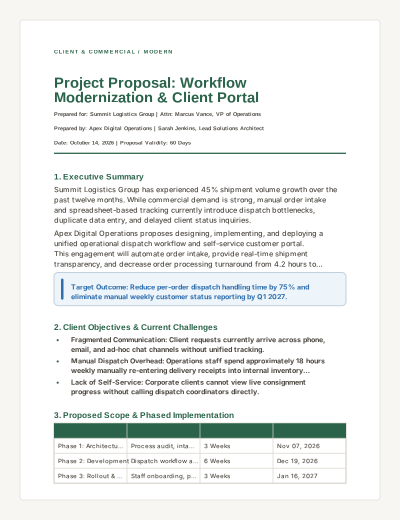
Business Proposal
A persuasive B2B proposal outline covering problem statement, solution, phased scope, pricing tables, and acceptance authorization.