Step-by-step tutorial 2026
How to Make Flashcards From Notes (Step-by-Step + Free Template)
Go from messy notes to focused question-and-answer cards with a worked biology example, a review routine, and a free printable template.
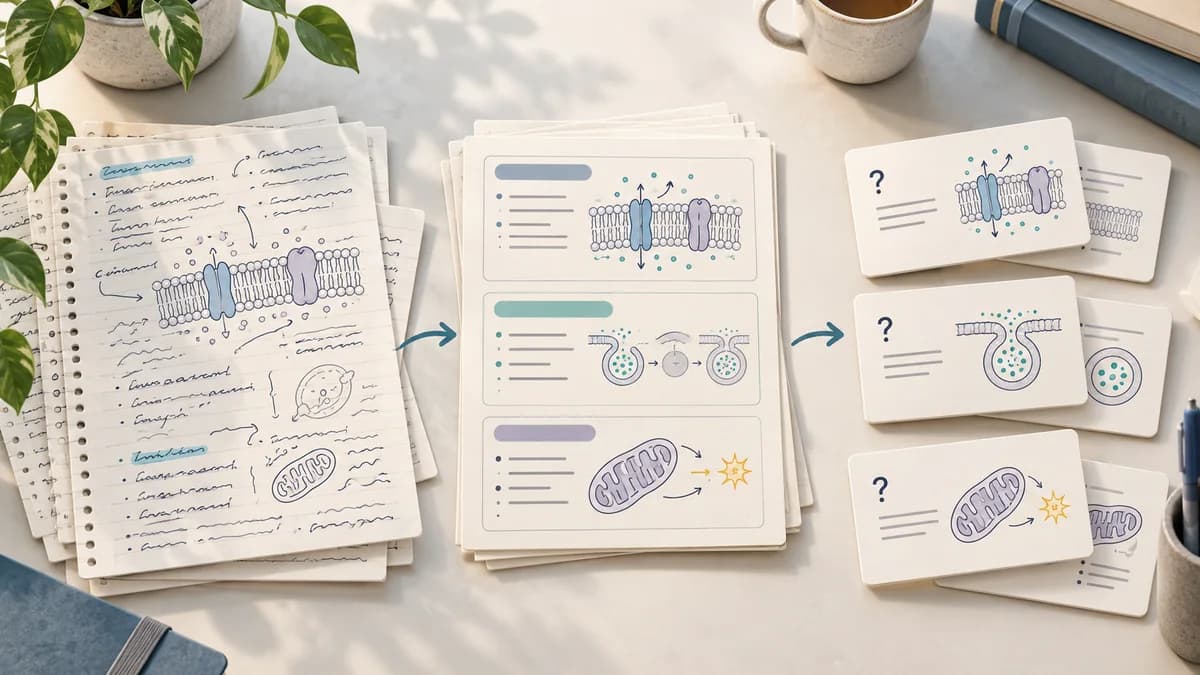
To make flashcards from notes, choose the ideas you need to remember, turn each one into a clear question, and write a short answer on the back. Check uncertain details against your course material, then test yourself before looking at each answer. The example below follows one set of biology notes from start to practice.
Why turn notes into flashcards?
Notes help you capture information; flashcards help you retrieve it. When you cover the answer and try to produce it from memory, you can see what you know and what still needs work. That is different from rereading a highlighted page, where the answer stays in view.
A flashcard deck also makes a large lecture easier to review in small sessions. You can mix definitions with cause-and-effect questions, compare related ideas, and bring back the cards you miss. Research reviews rate practice testing and spaced practice among the more useful study techniques across many subjects. They support learning; they do not guarantee a grade or replace understanding. See the research review from Dunlosky and colleagues and the classroom summary from the American Federation of Teachers.
What makes a good flashcard?
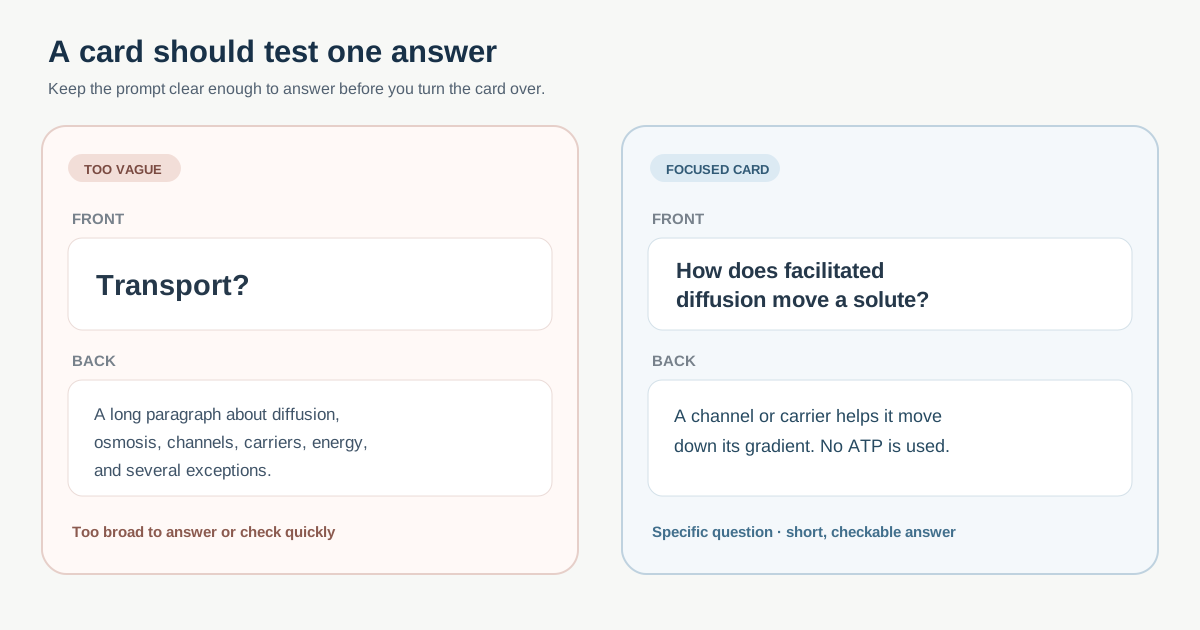
A useful card asks one specific question, gives enough context to stand on its own, and has an answer you can check quickly. It should make you recall the idea, not guess what the writer meant. If the answer needs a paragraph, split it or move the explanation into your notes.
| Weak prompt | Why it is weak | Stronger prompt |
|---|---|---|
| Cell membrane? | It names a topic but does not say what to recall. | What is the cell membrane mainly made of? |
| What happens? | There is no context, so many answers could fit. | What happens to water when an animal cell is in a hypertonic solution? |
| Explain transport. | Too broad for one quick answer. | How does facilitated diffusion move a solute across a membrane? |
| The cell membrane is selectively permeable, meaning it allows some substances through but not others. | This copies a note and shows the answer immediately. | What does selectively permeable mean? |
Cell membrane?
- Why it is weak
- It names a topic but does not say what to recall.
- Stronger prompt
- What is the cell membrane mainly made of?
What happens?
- Why it is weak
- There is no context, so many answers could fit.
- Stronger prompt
- What happens to water when an animal cell is in a hypertonic solution?
Explain transport.
- Why it is weak
- Too broad for one quick answer.
- Stronger prompt
- How does facilitated diffusion move a solute across a membrane?
The cell membrane is selectively permeable, meaning it allows some substances through but not others.
- Why it is weak
- This copies a note and shows the answer immediately.
- Stronger prompt
- What does selectively permeable mean?
Flashcards work especially well for terms, distinctions, causes, steps, and short explanations. Use a diagram you redraw from memory for structures. Keep a full mathematical derivation, a multi-page essay argument, or a hands-on skill in the format that actually practices it: worked problems, timed outlines, or supervised practice.
How to make flashcards from notes in seven steps
- Start with one lecture or reading. Give the set a clear label such as “Cell membrane — Week 3” so each card has a subject.
- Read your notes once for the main idea. Do not copy the page card by card; first notice the concepts and how they connect.
- Mark only testable ideas: key terms, contrasts, causes, steps, exceptions, or points your instructor emphasized.
- Check every question mark or incomplete line against your slides, textbook, or class source. Leave it out until you know the answer.
- Write the question first. Ask what you should be able to explain, predict, compare, or name without looking.
- Answer in your own words, keeping the back brief. Add a small context label when a prompt might be unclear later.
- Test the new cards immediately. Edit any card that feels ambiguous, has a wrong answer, or takes too long to check.
If your notes need sorting before you can tell which ideas matter, use the research-notes organizing method to group ideas by question or theme before making cards.
Worked example: from messy biology notes to a deck
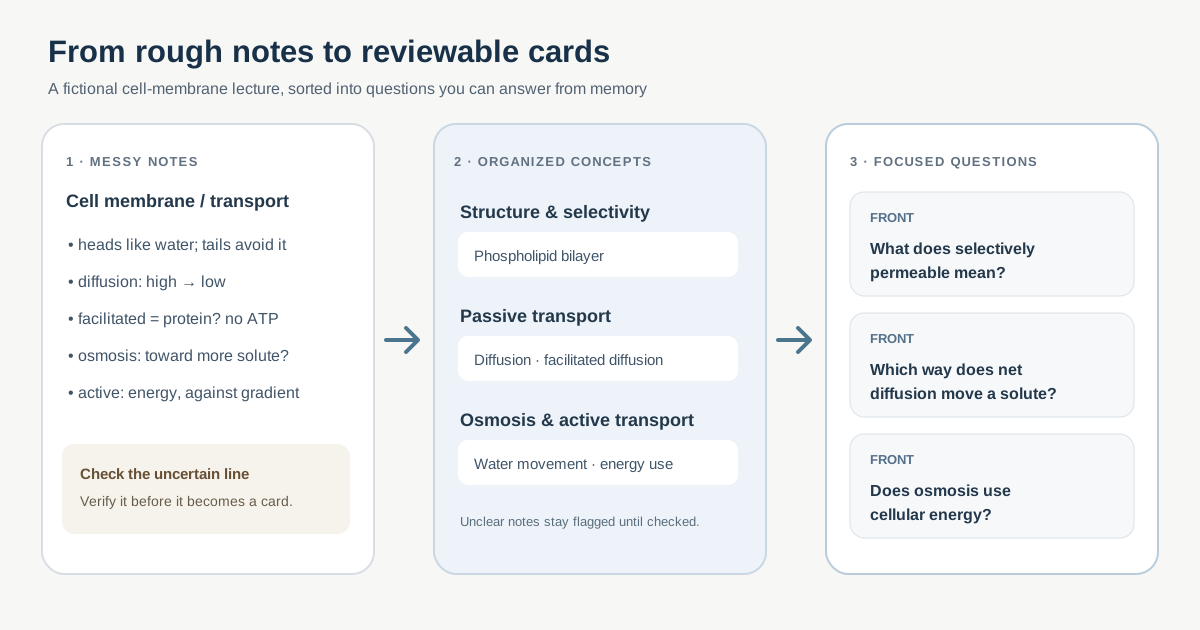
The following fictional example is for learning the process, not a real lecture transcript. The notes are about cell membranes and transport. Before turning them into cards, check the wording and level of detail your own course expects.
Original lecture notes
CELL MEMBRANE / transport
- phospholipid bilayer; heads like water, tails avoid it
- selective? some things pass, some need protein
- diffusion: high -> low
- facilitated = channel/carrier? passive, no ATP
- osmosis: water moves toward more solute (check conditions)
- active transport uses energy, moves against gradient
- hypertonic outside: water leaves animal cell; shrinks
- hypotonic outside: water enters plant cell; turgid
- isotonic: equal concentration? no net water movement
First, organize the ideas: (1) membrane structure and selective passage; (2) diffusion and facilitated diffusion; (3) osmosis and solution conditions; (4) active transport. The line marked “check conditions” is a reminder to verify the course’s definition, not a cue to invent an answer. For this introductory example, water moves net across a selectively permeable membrane toward the side with higher solute concentration, assuming comparable pressure.
Now rewrite each idea as a question with a checkable answer. Here are ten finished cards from the fictional notes:
| Front: question | Back: answer |
|---|---|
| What is the cell membrane mainly made of? | A phospholipid bilayer: two layers of phospholipid molecules. |
| Which parts of a phospholipid face the watery surroundings? | The hydrophilic heads face the watery environments; hydrophobic tails point inward. |
| What does selectively permeable mean? | Some substances pass through the membrane more readily than others. |
| Which way does net diffusion move a solute? | From an area of higher concentration toward an area of lower concentration. |
| How does facilitated diffusion move a substance across a membrane? | A channel or carrier protein helps it move down its gradient; the process does not use ATP. |
| What is osmosis? | The net movement of water across a selectively permeable membrane toward the side with higher solute concentration in this simple example. |
| Does osmosis require cellular energy? | No. Osmosis is passive transport. |
| What happens to an animal cell in a hypertonic solution? | Water leaves the cell, so the cell shrinks. |
| What happens to a plant cell in a hypotonic solution? | Water enters; the vacuole expands and turgor pressure rises, while the cell wall helps prevent bursting. |
| How is active transport different from facilitated diffusion? | Active transport uses energy to move against a gradient; facilitated diffusion moves down a gradient without ATP. |
What is the cell membrane mainly made of?
- Back: answer
- A phospholipid bilayer: two layers of phospholipid molecules.
Which parts of a phospholipid face the watery surroundings?
- Back: answer
- The hydrophilic heads face the watery environments; hydrophobic tails point inward.
What does selectively permeable mean?
- Back: answer
- Some substances pass through the membrane more readily than others.
Which way does net diffusion move a solute?
- Back: answer
- From an area of higher concentration toward an area of lower concentration.
How does facilitated diffusion move a substance across a membrane?
- Back: answer
- A channel or carrier protein helps it move down its gradient; the process does not use ATP.
What is osmosis?
- Back: answer
- The net movement of water across a selectively permeable membrane toward the side with higher solute concentration in this simple example.
Does osmosis require cellular energy?
- Back: answer
- No. Osmosis is passive transport.
What happens to an animal cell in a hypertonic solution?
- Back: answer
- Water leaves the cell, so the cell shrinks.
What happens to a plant cell in a hypotonic solution?
- Back: answer
- Water enters; the vacuole expands and turgor pressure rises, while the cell wall helps prevent bursting.
How is active transport different from facilitated diffusion?
- Back: answer
- Active transport uses energy to move against a gradient; facilitated diffusion moves down a gradient without ATP.
Try a short practice round before you file the deck away. Cover the answers and answer cards 3, 5, 8, and 9 aloud. Suppose you correctly define selective permeability, say facilitated diffusion moves against the gradient, predict that water enters a plant cell in a hypotonic solution, and explain why the cell wall matters. Mark cards 3 and 9 ready, revisit card 5 soon because its direction was reversed, and explain card 8 again without looking. That correction is useful study data.
A free printable flashcard template
Free printable PDF
Download the free printable flashcard template
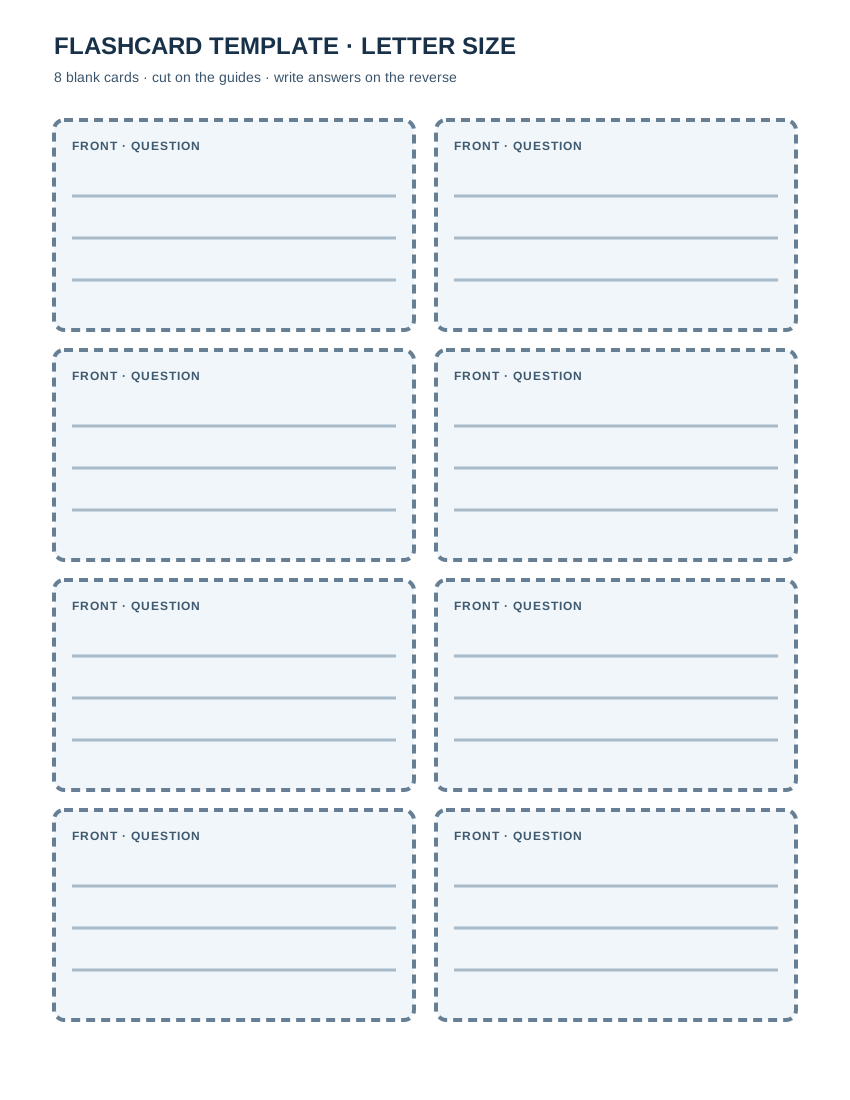
Print one Letter-size sheet with eight blank cards, then use the filled example page to see how a short prompt and answer fit on a card. No account or email is required.
- Eight cut-out flashcards on the blank sheet
- A second page with filled biology examples
- Print on standard US Letter paper
- Cut along the light guides; write the answer on the card’s reverse
Free PDF · No account or email required · US Letter paper
Make flashcards manually or use AI drafts
Manual cards are free, private, and useful when writing the question helps you process a difficult idea. Index cards, paper, or a simple document are enough. The tradeoff is time: you select every idea and write every question yourself.
An AI tool can draft cards from material you give it, which may save setup time. Treat its output as a first draft. Check each answer against your notes, remove unsupported claims, split broad questions, and rewrite the wording so it matches your course. Do not upload material you do not have permission to share.
Open Study, select “Study This,” name the set, optionally choose a course, then select existing Docs or Presentations. In the set, choose Generate under Study Guide, Flashcards, or Practice Quiz. Results are grounded in those workspace items; the selector is for Docs and Presentations, not arbitrary PDFs.
Study generation uses AI. Pro and Business currently include all AI features with usage controls; Free has no AI generation. Check current pricing before starting. The student page describes the same flow. The printable method here works without an account or paid tool.
Review with active recall and spacing
Look at the question, hide the answer, and give yourself a real attempt before flipping the card. Say or write the answer if a silent “I know that” is too easy. Then compare your response with the back: count it correct only when it answers the question accurately, not when it merely sounds familiar.
A simple starting routine is to test new cards the same day, review missed cards the next day, and return to the whole set a few days later and again the following week. Move a card sooner if you miss it; leave more time when recall is easy. The exact calendar is a practical starting point, not a one-size-fits-all rule. If you are planning a larger assignment, the student research project timeline can help you protect study time.
Five flashcard mistakes to avoid
- Copying whole paragraphs. Ask one question and shorten the answer; keep the full explanation in your notes.
- Making every detail a card. Prioritize what your course asks you to remember, explain, or apply.
- Leaving questions vague. Add the subject or context so the card still makes sense a week later.
- Trusting a guess or AI draft. Verify biology, formulas, dates, and exceptions with your assigned material.
- Making cards but never testing them. A deck helps only when you retrieve, check, and revisit the answers.
Frequently asked questions
Is there an app that turns notes into flashcards?
Yes. Several study apps can draft cards from notes. In ZuffSuite, Study uses selected Docs or Presentations in your workspace to generate flashcards, a study guide, or a quiz. AI generation is on Pro or Business with usage controls; the printable method here does not require an app.
Can ChatGPT make flashcards?
A text assistant can draft question-and-answer cards from notes you provide. Ask it to use only your material, list unclear points separately, and keep each answer short. Then verify the biology, formulas, and course-specific wording yourself.
Can Quizlet make flashcards from my notes?
Quizlet currently promotes Study Guides that can turn class notes into flashcards and other study materials. Its current upload options and access limits can change, so check the Quizlet Study Guides page before you depend on a particular file type or plan.
How can I turn notes into a study guide?
Group related notes under the lecture’s main questions, define key terms, write a short summary in your own words, and list what remains unclear. Make flashcards for details you need to retrieve; keep longer explanations, diagrams, and connections in the guide.
How can I make flashcards from notes online for free?
Use a free document or paper index cards: write a question on one side, the answer on the other, and review before looking. The printable PDF above includes eight blank cards per Letter-size sheet and a filled example page. It does not ask for an account or email.
Take the cards into your next study session
Start with one page of notes. Sort the ideas, write a focused prompt for each one, and test yourself before you look. If the notes are part of a group presentation, the college group presentation guide can help your team divide the project; use flashcards for the terms and ideas each person needs to explain.
Keep exploring
More guides for your work
Step-by-step tutorial Oct 3, 2026
How to Organize Research Notes for Papers and Presentations
Keep evidence connected to sources, compare ideas by theme, and turn organized notes into a useful outline.
Read the guide
Planning guide Oct 3, 2026
How to Plan a Student Research Project: Timeline and Checklist
A four-week example and copyable checklist for moving from an assignment question to a reviewed submission.
Read the guide
Student field guide Oct 13, 2026
How to Organize a College Group Presentation: Roles, Slides, Deadlines & Checklist
Divide the work fairly, build one clear slide story, and finish with time to rehearse. Includes a three-student example and a free planning kit.
Read the guideA workspace for what comes next
Turn class notes into a focused study session.
Select a Doc or Presentation in Study to generate a flashcard set or study guide with ZuffSuite's AI tools.