Workflow playbook 2026
A Simple Project Intake Process for Freelancers, With a Form Template
Turn an incoming request into a clear decision, a usable brief, and a manageable project plan.
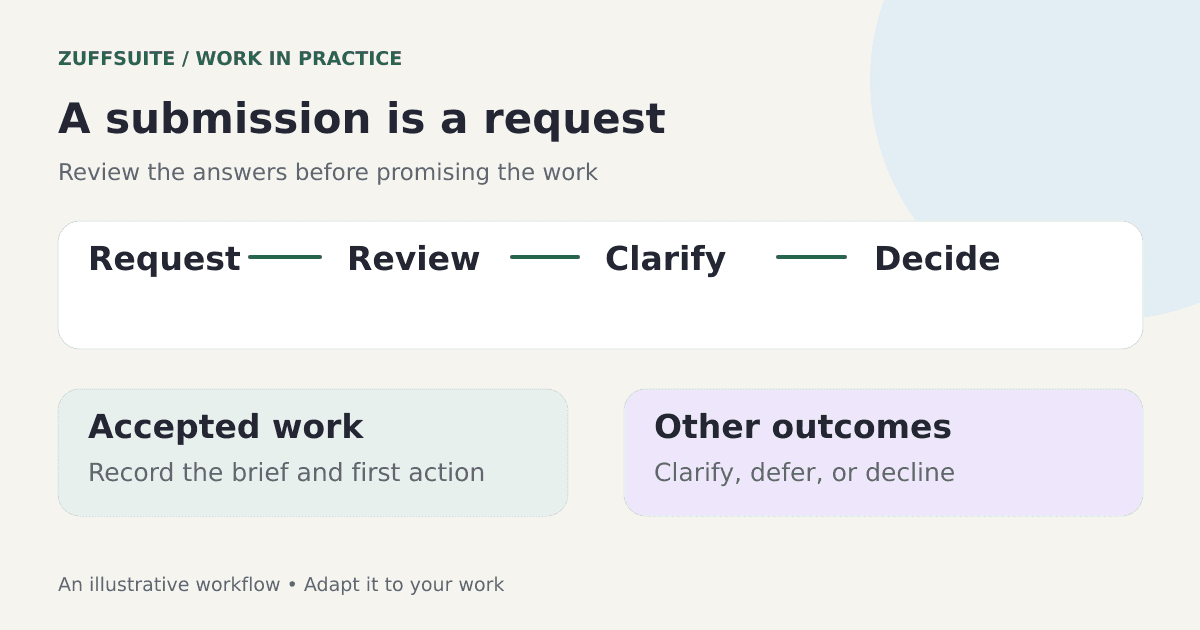
A freelance project intake process turns an incoming request into enough information to decide what happens next. Collect the desired outcome, deliverables, timing, available inputs, and relevant constraints. Review the answers, clarify what is missing, then decide whether to accept, defer, or decline the work. When you accept it, record the agreed project and its first actions.
The intake form is one part of that process. A completed form is not automatically an approved brief or a promise to meet the requested deadline. You still need to interpret the request and compare it with your capacity. Keeping that decision visible helps you avoid treating every submission as work you have already agreed to deliver.
This playbook includes a copyable client project questionnaire and a fictional presentation request showing how to use it. You can use the questions in a document, email, or form. Download the plain-text project intake worksheet if you want a blank version to customize before sending it to a client.
Choose what intake should accomplish
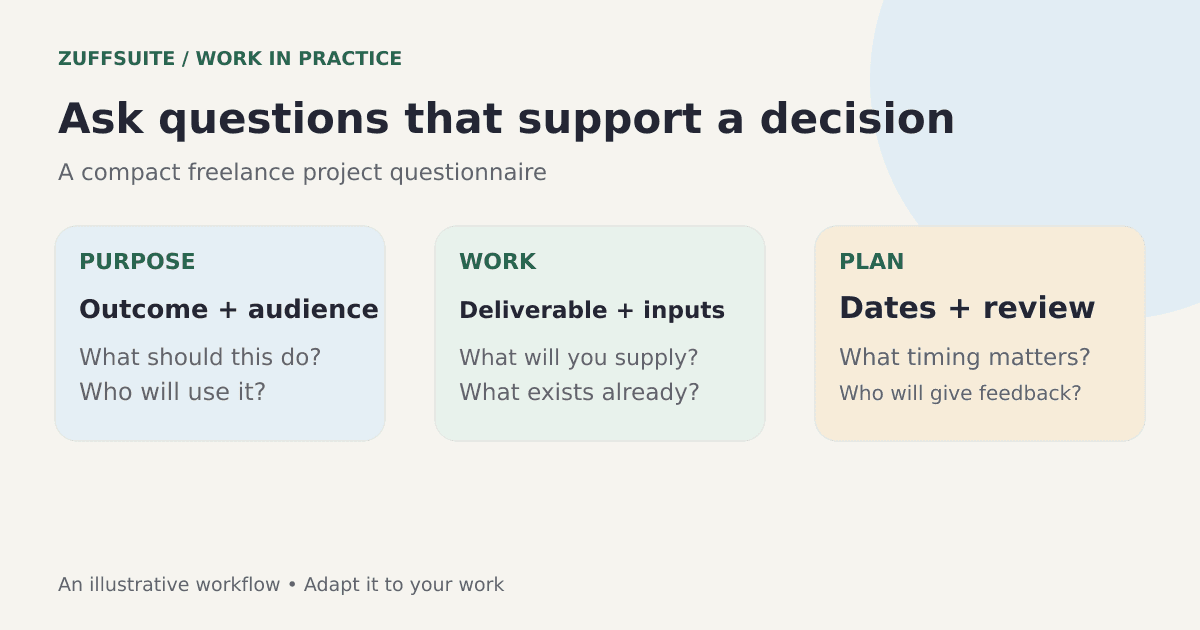
Before writing questions, decide which decisions the answers must support. For a solo freelancer, those decisions often include whether the work fits your services, whether the requested timing is possible, what information you need before beginning, and what should be clarified before discussing a detailed scope.
Collect enough information for the next conversation. You do not need to ask a potential client to write a complete strategy before you have spoken. A long questionnaire can produce less useful answers if the person does not yet know what they need. Start with a compact form and ask follow-up questions where the answers reveal uncertainty.
Also decide what response the client will receive after submission. Explain that you will review the request and contact them about next steps. If you have a normal review period, communicate it accurately. Do not invent a guaranteed turnaround simply because a form template has a place for it.
For the broader transition after a project is accepted, use our client onboarding guide. This article focuses on understanding and evaluating the request that comes before that transition.
Copy this freelance project intake form template
Use these sections as a starting point. Remove questions that do not influence your work, and add specialized questions only when they help you assess the request. Mark essential fields clearly so the client understands what you need to review it.
| Section | Questions to ask |
|---|---|
| Contact | What is your name, preferred contact method, and organization if relevant? |
| Outcome | What are you trying to accomplish, and who is the work for? |
| Deliverables | What do you want to receive: a document, presentation, design, or another output? |
| Timing | When do you need it, and what event or dependency determines that date? |
| Inputs | Which source materials, examples, files, or decisions are already available? |
| Constraints | Are there requirements about length, format, brand, accessibility, or review? |
| Scope | What is already agreed, and what still needs to be defined? |
| Review | Who will provide feedback, and who can confirm the final direction? |
| Context | Is there anything else that could affect the work or schedule? |
Contact
- Questions to ask
- What is your name, preferred contact method, and organization if relevant?
Outcome
- Questions to ask
- What are you trying to accomplish, and who is the work for?
Deliverables
- Questions to ask
- What do you want to receive: a document, presentation, design, or another output?
Timing
- Questions to ask
- When do you need it, and what event or dependency determines that date?
Inputs
- Questions to ask
- Which source materials, examples, files, or decisions are already available?
Constraints
- Questions to ask
- Are there requirements about length, format, brand, accessibility, or review?
Scope
- Questions to ask
- What is already agreed, and what still needs to be defined?
Review
- Questions to ask
- Who will provide feedback, and who can confirm the final direction?
Context
- Questions to ask
- Is there anything else that could affect the work or schedule?
If budget is relevant to your initial assessment, ask for a budget range or whether one has been set. Allow a useful answer such as “not yet decided” rather than forcing an invented number. A budget answer can support a conversation, but it does not establish an agreed price by itself.
For sensitive material, ask only for what you need at this stage. A general project request rarely requires a client's passwords or unnecessary personal information. Describe how files should be supplied through your agreed channel rather than encouraging people to place credentials in a free-text answer.
Review the answers in a consistent order
Read the intended outcome before evaluating the requested format. A client may ask for a presentation when their real need is a concise document for a small group. You can discuss the format after understanding how the work will be used. Intake should make that conversation easier, not prevent it.
Next, inspect the deliverables and timing. “A short presentation by Friday” still leaves questions about audience, content, research, and review. Check what must happen before you can create a usable first version. A requested date may depend on an event, or it may simply be the client's first preference.
Then look at inputs and constraints. Missing source material can matter more than the apparent size of the output. A five-slide deck based on approved notes differs from a five-slide deck requiring research and several interviews. Record that distinction before estimating the work.
Finally, identify the decisions that remain open. Write a short follow-up list rather than rewriting the whole questionnaire. This keeps the next conversation focused on the information most likely to affect scope and timing.
Worked example: a presentation request
Imagine a fictional client, Harbor Learning, requesting a presentation for an upcoming workshop. The form says “ten slides, needed in two weeks,” and links to a folder of notes. The intended audience is described only as “participants.” The client wants clear visuals but has not identified the central message.
The request is useful enough to start a conversation, but it is not yet a complete brief. You need to know who the participants are, what they should understand afterward, which notes are approved, and when feedback can be returned. Ask those questions before scheduling extensive design work.
After clarification, the client explains that participants are new instructors and the presentation should introduce three workshop activities. The approved notes contain the required content. The first review can happen several days before the workshop. You can now describe a concrete deliverable with a meaningful review step.
Record the result in a short brief: audience, objective, slide scope, supplied materials, first draft date, review contact, and final delivery arrangement. Mark anything still awaiting confirmation. This brief is the bridge from the original request to the project you actually agree to undertake.
Make an explicit decision before creating the work
Give each reviewed request an understandable outcome. It can be accepted, awaiting clarification, deferred, or declined. Add a sentence explaining the next step. A status alone is not enough if neither person knows who should act next.
Accept when you have enough information and can agree the scope and timing. Ask for clarification when a missing answer affects the decision. Defer when the work may fit later but does not fit your current availability. Decline when it is outside your services or you cannot offer a suitable arrangement.
For the fictional presentation, you might accept after the audience and materials are confirmed. The next action becomes “draft the outline from approved notes.” That is a better starting point than treating the initial form submission as permission to build a deck based on assumptions.
If you manage several clients, compare the request with your active project overview. Intake is the moment to assess capacity, before another promised date joins an already crowded week.
Turn the accepted brief into a small project plan
List the deliverable and the steps needed to create it. For the presentation, those steps might include outlining, drafting slide content, selecting visuals, checking the first version, collecting feedback, revising, and preparing the final file. Adapt the sequence to the actual assignment.
Record dependencies alongside the actions they affect. If a photograph needs client approval, make that visible before the design stage that uses it. If the audience description is still tentative, avoid treating it as a settled input. A useful plan keeps important uncertainty connected to the work it can change.
Choose the first action you can complete. Keep later tasks simple until the early decisions are resolved. Planning every possible revision in advance can create more administration than clarity. You need enough structure to begin and a way to update the plan as the project develops.
Our freelance project tracker template supplies a small overview for accepted work. Keep pending requests separate from active commitments so a proposed project does not appear to be a promise you have already made.
Set up the questionnaire in ZuffSuite
ZuffSuite Forms can hold a structured questionnaire, Documents can hold the clarified brief, and Sheets can hold your project overview. Use the questions in this article to build the intake form around your service. Test the form with an illustrative response before sharing it.
Check that the questions are understandable and that the answers give you what you need to review a request. Read the submission as if you were seeing the project for the first time. If the answers still leave the same essential questions unanswered, improve those prompts rather than simply adding more fields.
Review submissions before creating or updating your project plan. The method here works with deliberate manual steps: read the answers, agree the brief, and record the resulting actions. It does not require an automatic form-to-task integration. Choose any connected workflow only after confirming how it behaves in your workspace.
Keep later changes from becoming invisible intake
Existing clients can make new requests during a project. Apply the same questions in a lighter form: what outcome is requested, what timing matters, what inputs exist, and how does it affect the current deliverable? A familiar client does not remove the need to understand new work.
When the request is feedback on a current draft, use the client feedback and revisions checklist. When it creates a new output, record a separate deliverable. That distinction makes your overview easier to understand and helps the client see what will happen next.
Keep a record of the agreed change in the brief or decision notes. You do not have to repeat a full onboarding process for every adjustment. You do need enough written context to resume the project without relying on a remembered conversation.
Common intake mistakes and how to fix them
Asking questions you never use
If an answer does not affect your assessment or the next conversation, consider removing it. Intake becomes more useful when each question has a purpose. Specialized fields can be valuable, but they should reflect the service you actually deliver rather than a generic template's assumptions.
Treating a desired deadline as an agreement
A date entered in a form describes a request. Confirm what you can offer after reviewing the work and inputs. Record the agreed date separately when it differs. This prevents your internal tracker and the client's expectations from quietly developing different versions of the plan.
Starting before the important decisions are clear
You can gather context early, but be careful about building a detailed output against unresolved assumptions. Identify which unknowns would cause substantial rework. Resolve those before investing heavily in the next stage, or agree explicitly what exploratory work is being done.
Making the client repeat the same information
Carry useful answers into the brief rather than asking for them again in another form. Clarify what changed or what was missing. The point of a project intake process is to preserve useful context as the work moves forward.
For additional examples, Smartsheet's intake form collection shows several service-specific formats. Use them as inspiration for question types, then keep your own questionnaire focused. You can start a ZuffSuite workspace and put the copyable form, brief, and project overview together for your next request.
About this guide: ZuffSuite used AI-assisted drafting to prepare this article. The diagrams and worked examples illustrate the method; they are not customer case studies. Linked references provide background, and the worksheets are available for you to adapt.
Keep exploring
More guides for your work

Step-by-step guide Sep 27, 2026
Client Onboarding Process for Small Business: A Step-by-Step Guide
A good onboarding process makes the next step obvious to both the client and your team. Here is a seven-stage process, a worked example, and a checklist you can use.
Read the guide
Field guide Oct 3, 2026
How to Manage Multiple Freelance Client Projects Without Losing Track
A worked three-client week, a small project overview, and a repeatable review to keep commitments clear.
Read the guide
Template walkthrough Oct 3, 2026
Freelance Project Tracker Template: Clients, Tasks, and Deadlines
Copy the blank tracker, learn each field, and build a small overview you can maintain yourself.
Read the guideA workspace for what comes next
Give your next project one clear home.
Keep notes, documents, tasks, and presentation work together in a personal workspace. Share something when you choose.